Meta Andromeda 2.0: The technical AI promise vs. the hard reality of the media buyer
Why Meta’s Andromeda, GEM and GenRecs sound impressive — and why high-ticket funnels without guardrails still stall on budget cannibalization.
Promise vs. practice
In late October 2026, Meta Engineering published a series of deep technical papers on the transformation of its advertising infrastructure. Across the market and industry forums, “Andromeda 2.0” quickly became the umbrella name for this update.
The promise from Meta for Business sounds compelling: with advanced AI models and new hardware architectures, the auction is smarter than ever. Every ad in your account gets a fair shot, new creatives are understood faster, and the system predicts which prospect needs which message at which moment.
But anyone who day-to-day manages complex B2B, high-ticket, or specialized lead-gen campaigns recognizes this pattern: you launch a thoughtful funnel with in-depth expert videos, informative statics, and a closing action creative. Within 24 hours the algorithm has dumped 95% to 98% of the daily budget into one flat offer. The educational carriers—the ones that need to build trust—stall on a handful of impressions and a few cents of spend.
How does Meta’s impressive AI theory relate to daily life in Ads Manager? In this article we dig into the tech behind Andromeda, GEM and GenRecs, explain why the auction still tends toward budget cannibalization, and share the operational playbook we use as an agency to take back control of media spend.
Part 1: Under the Hood of Meta’s AI Ranking (The Three Innovations)
To understand what is changing, you first need to know how Meta decides which ad a user sees. It is not one magic step, but two sequential phases:
Retrieval (Preselection): Within milliseconds, a pool of tens of millions of potential ads is reduced to a compact shortlist of strong candidates.
Ranking (The Auction): Those remaining candidates are scored heavily on bid, quality and expected action rate, after which the eventual winner takes the impression.
The technical updates Meta shipped touch the full width of this pipeline.
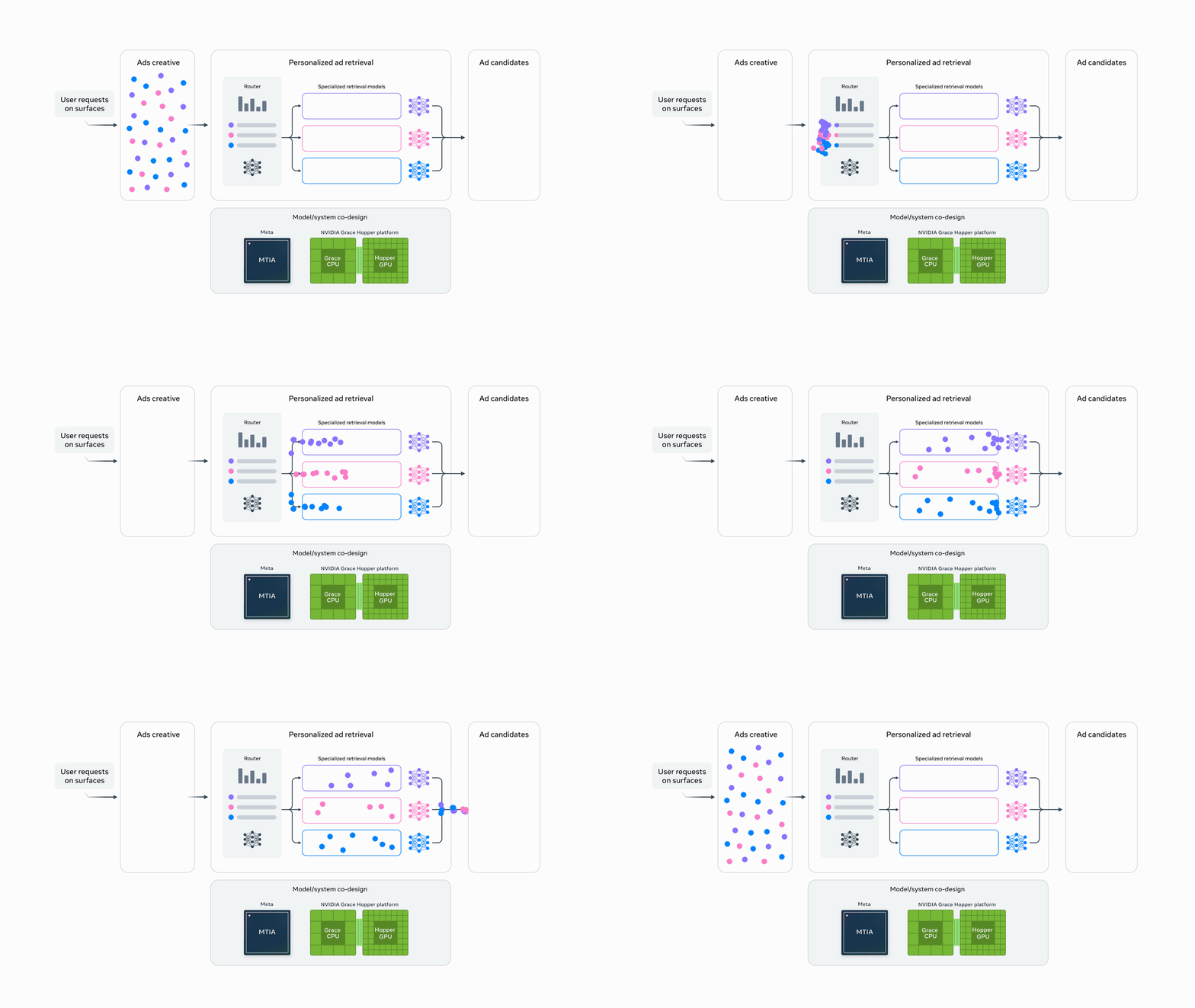
Meta’s personalized ad retrieval pipeline: from ads creative via router and specialized models to ad candidates — co-designed with Meta MTIA and NVIDIA Grace Hopper.
1. Meta Andromeda (Next-Gen): The Concierge That Reads Every Shelf
Andromeda is Meta’s engine for the first phase: Retrieval. Where Andromeda in 2024 mainly focused on model depth (understanding complex signals on the NVIDIA Grace Hopper GH200), the latest iteration is about smart breadth.
In the old setup the system had to take shortcuts to stay within strict latency limits (milliseconds): it skipped branches of ads that historically looked less relevant. Meta used the metaphor of a hotel concierge: previously he only looked at the most popular shelves. Now he walks the entire inventory in the same amount of time and reads every individual label.
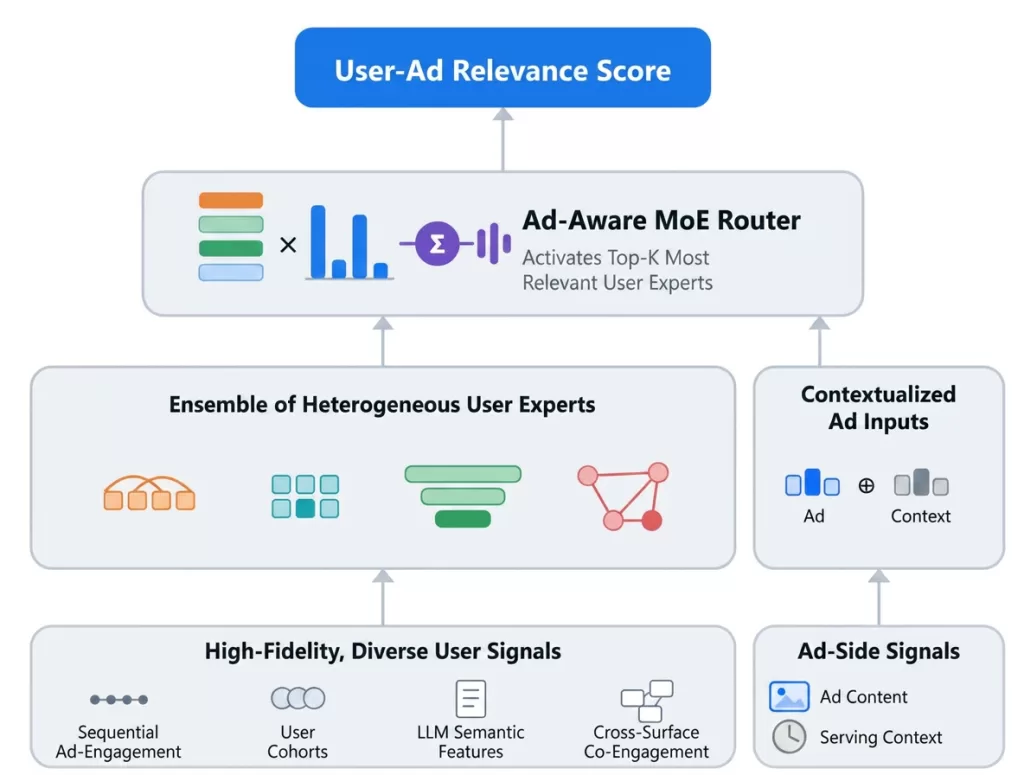
Andromeda Retrieval MoE: the Ad-Aware MoE Router activates the most relevant user experts for a User-Ad Relevance Score.
The Technical Breakthrough
Mixture-of-Experts (MoE) architecture: Instead of one heavy model that must compute everything for everyone, Andromeda now uses an ensemble of specialized “User Towers” (experts). An Ad-Aware MoE Router activates only the most relevant sub-experts per creative. That brings the expressiveness of the heavy ranking phase into retrieval, at roughly 300× less compute (FLOPs).
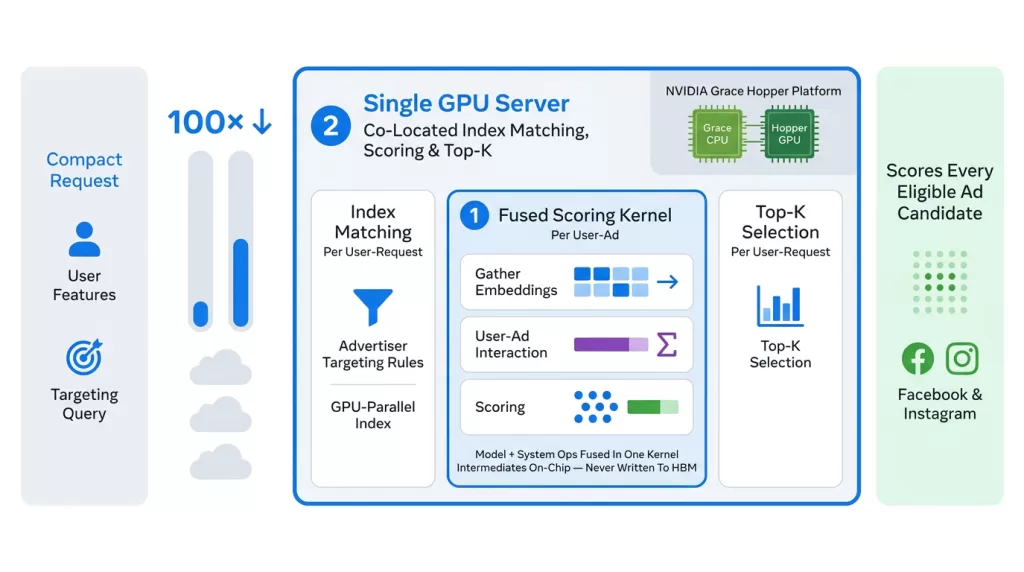
Single fused GPU pipeline: Previously CPU hosts (handling targeting rules and index matching) talked over the network to remote GPUs (computing scores). By fusing the full process—from index matching to scoring and top-K selection—into a single on-chip GPU kernel, network load dropped by a factor of 100.
Throughput: In production the system scores more than one billion ads per second per GPU server.
Single fused GPU pipeline on NVIDIA Grace Hopper: index matching, scoring and top-K in one kernel.
What this means: Virtually every active, approved ad in your account is actually considered and scored per individual user. The era of creatives being technically ignored during first-pass filtering is over.
2. Meta GEM: The Central Brain That Teaches the Whole Class
GEM stands for Generative Ads Recommendation Model. Where traditional models optimized in isolation per placement (Feed vs. Reels) or campaign objective (Leads vs. Purchases), GEM acts as a foundational model.
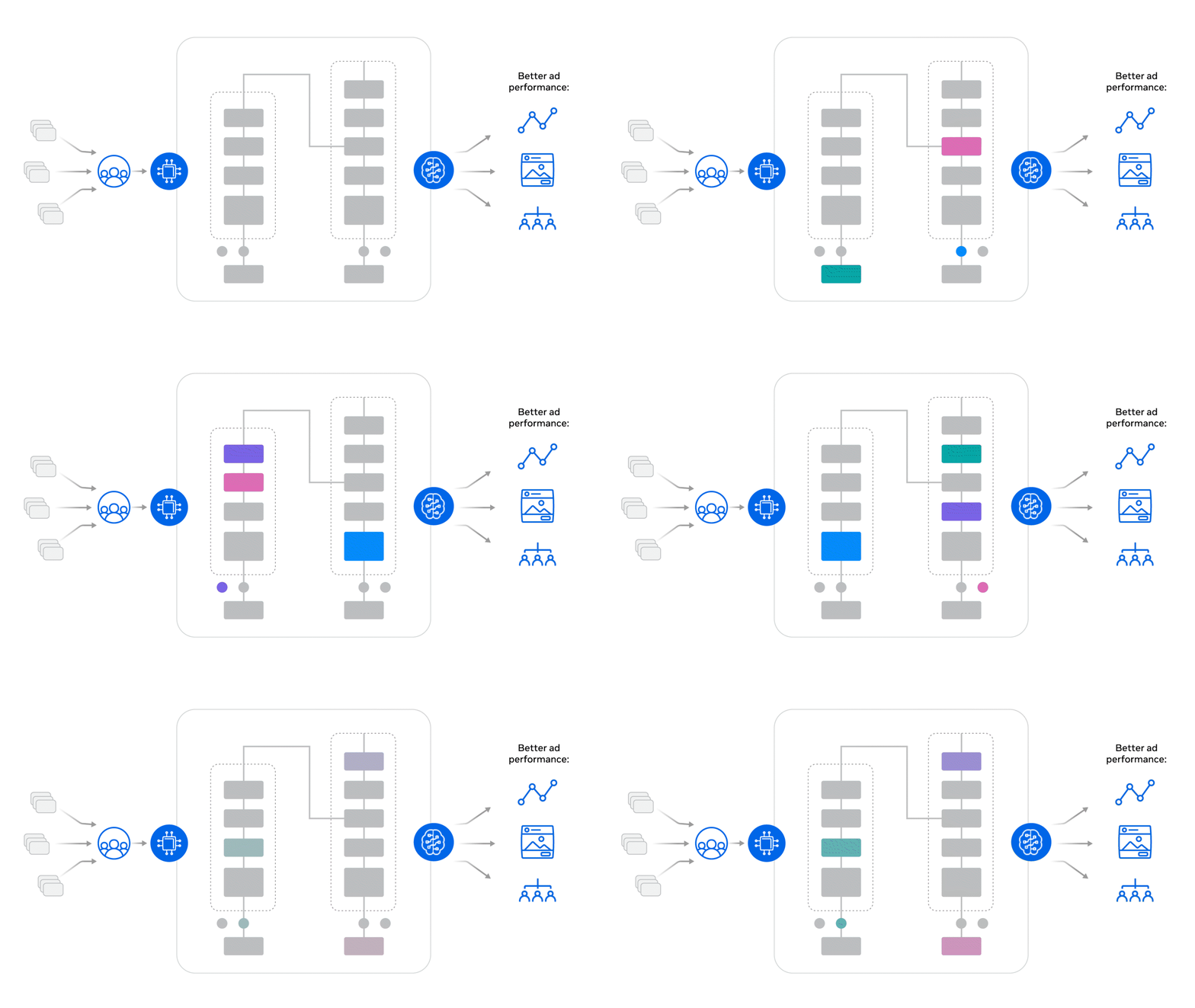
GEM acts as a central model that transfers knowledge into real-time ranking models — with better ad performance as the outcome.
Meta compares GEM to a professor at LLM scale. The model analyzes hundreds of millions of user patterns across all surfaces (Facebook, Instagram, Reels, offsite web conversions) and builds a deep memory of how people move from interest to transaction.
Instead of serving every impression itself live, GEM applies knowledge transfer. It teaches specialized real-time ranking models how to act. Campaigns that naturally produce less conversion volume (niche B2B journeys or specialist appointment funnels) therefore benefit directly from data GEM learns in high-volume e-commerce funnels. The model reads roughly twice as long an engagement history through a model that is about 2.5× more complex.
3. Meta GenRecs: Semantic Intelligence and Generative Retrieval
A stubborn problem in advertising machine learning is the cold-start problem: a brand-new ad has no historical clicks or conversions yet, so the algorithm does not know who to reach.
GenRecs (Generative Recommender) solves this via GenRecs tokenization:
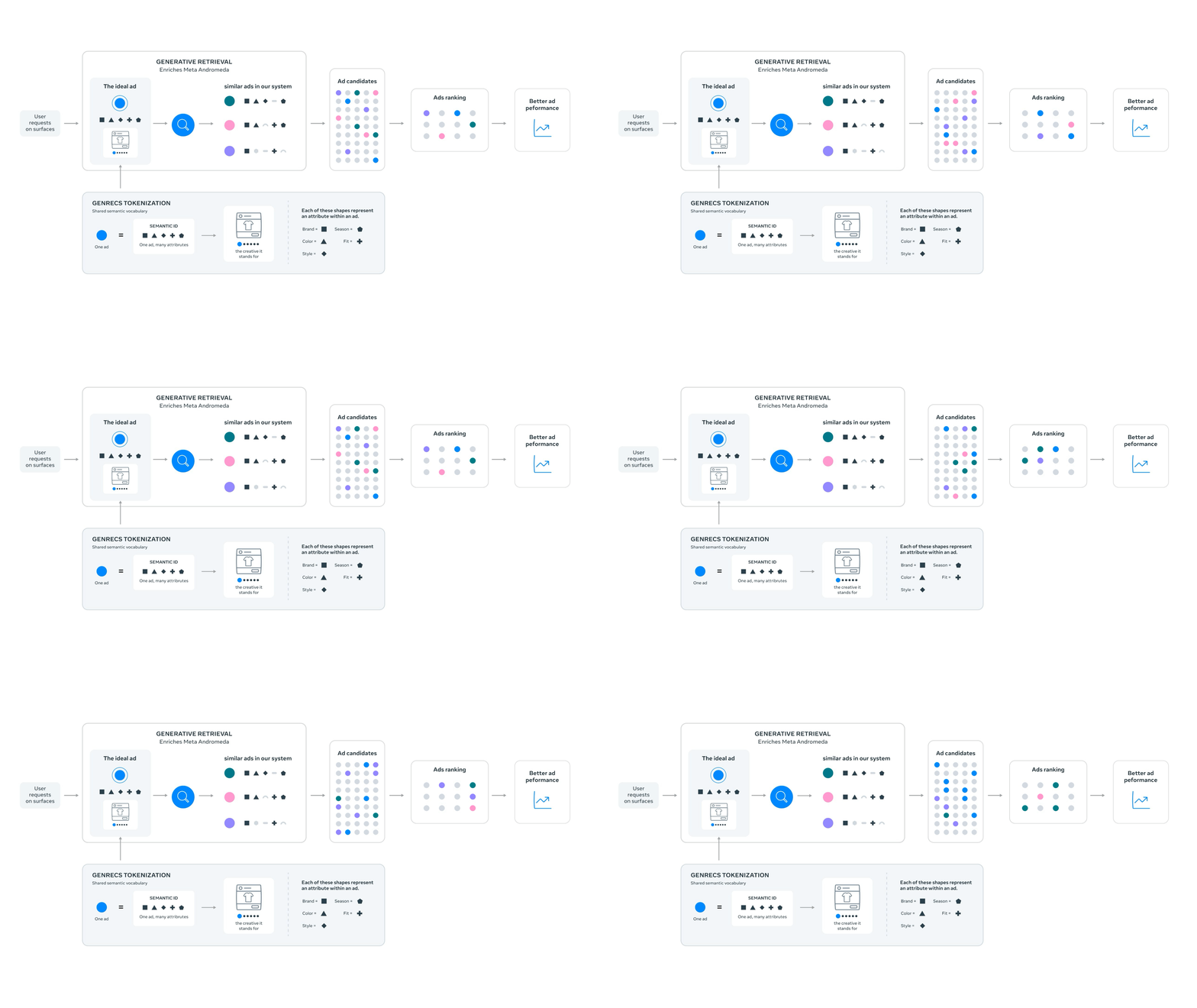
GenRecs tokenization and generative retrieval: semantic IDs match new creatives without click history.
Multimodal semantic tokens: Large language models dissect the creative before a euro is spent. Image, audio, copy and context are translated into semantic tokens (e.g. style, mood, shown problem, value proposition).
Generative retrieval: Instead of only looking at historical patterns (“who clicked this yesterday?”), the model reasons what the ideal ad for a specific user should be. It generates a semantic profile of the desired message and searches the ad pool for the creative closest to that profile.
New concepts can therefore be matched more precisely from day one — even with zero click history.
"A spot on the shortlist (Retrieval) is not yet an impression (Ranking)."
Part 2: The Hard Reality (Why Accounts Still Stall)
If Andromeda scores every creative, GEM feeds models with universal buying patterns, and GenRecs understands new ads immediately — why do media buyers still see this in practice?
Creative
Type
Spend
Reach
Ad A: expert video
Video
€ 0.67
60
Ad B: explainer / static
Static
€ 0.59
50
Ad C: action creative
Static
€ 55.15
2,636
Total
€ 56.41
2,746
Real-world example (anonymized): one action creative captures almost the entire daily budget while educational carriers stay on a ration.
The answer sits in a fundamental split that analytics platform Segwise captures well: a spot on the shortlist (Retrieval) is not yet an impression (Ranking).
Phase
What happens
Andromeda 2.0: Retrieval
“I put all three creatives on the shortlist for the user.”
The auction: Ranking
“The action creative picks up fast clicks in the first hour. I throw 98% of the budget there.”
Retrieval ≠ impression: being on the shortlist says nothing about where the budget actually goes.
1. The Auction Is Opportunistic and Short-Sighted
Meta’s auction formula weighs three components:
Total value = Bid × Estimated action rate + Ad quality
When you place an educational video (asking for 45 seconds of attention and cognitive processing) in the same ad set as a static banner with a hard action trigger or price focus, an unfair dynamic appears:
Curious scrollers quickly click the offer in the first hours to see what it is.
The auction algorithm sees estimated action rate (CTR) spike on that specific creative.
Because Meta optimizes for auction profit maximization, within about 12 hours almost the entire daily budget is routed to that creative.
2. The Algorithm Does Not Understand Human Decision-Making
In B2B, professional services and medical journeys, nobody converts cold off a discount banner. A prospect needs context first:
Who are you?
Do you understand my friction or symptom?
Why are you the authority to solve this?
Meta’s optimization AI only sees the macro statistic: “Lots of clicks for little money.” That those visitors bounce within three seconds on the landing page because zero authority was built (resulting in 0 conversions) is not self-corrected. The educational video that could have built that trust has already been rationed to €0.67 spend by the algorithm.
Part 3: The Agency Playbook — How We Take Back Control
Blind trust in Meta’s automation ends in hollow funnels and frustrated clients. As media buyers we must feed the AI where it is strong — and set software guardrails where it falls short.
These are the three operational pillars we use across our accounts:
Pillar 1: Force Data with Push Delivery
When a dominant creative hijacks the budget and new strategic carriers (videos or deeper statics) never get a chance to build traction, we do not intervene with the manual pause button. Pausing creatives disrupts the ad set’s learning phase.
Instead we use push delivery at ad level:
The setting: Allocate 20% to 30% of the daily campaign budget to the lagging test ads for a period of 7 days.
Why 7 days? That matches Meta’s learning cycle. After 7 days the educational creative has received hundreds to thousands of impressions and the algorithm can measure real user interaction. Then the push stops automatically and CBO distribution can steer on natural data again.
Why not above 30%? You do not want to flatten the ongoing lead flow from your other creatives; 70% to 80% of budget stays freely available for proven converters.
Pillar 2: Concept Diversification (Real Variation for the MoE Router)
Because Andromeda 2.0 uses a Mixture of Experts, traditional micro-level A/B testing is outdated. Uploading ten ads with the same video but a different button color or marginally different typeface adds no value for Meta. The algorithm sees the same semantic token ten times and clusters them under one concept.
If you want Meta’s router to speak to different buyer types, you need conceptual diversity:
Angle A: Pain
Angle B: Logic
Angle C: Authority
Focus on friction, loss and urgency. Speaks to emotional decision-makers.
Focus on method, efficiency and process. Speaks to rational decision-makers.
Focus on reviews, certification and proof. Speaks to risk-averse decision-makers.
Concept diversification for Andromeda: three fundamentally different psychological angles.
Segwise uses a useful rule of thumb for creative auditing:
Summarize every active ad in one neutral sentence, without naming colors, fonts or buttons. Do two ads get the same sentence? Then they are not two concepts — they are iterations of the same idea.
Pillar 3: Structural Budget Guardrails (The €150 / Day Threshold)
To stop ads inside a set from cannibalizing each other, we use a strict budget architecture:
Daily budget per pillar
Campaign structure
How we test and rotate
Up to €150 / day
Direct CBO
Max 3–4 active creatives at once (1 video + 2 statics). Rotate in 6–8 week batches via a new ad set so learning does not reset.
≥ €150 / day
ABO test → CBO scale
20–30% of budget in a dedicated ABO test environment. Duplicate winners into the scale CBO with ad set minimums.
Rule of thumb: keep it compact under €150/day; above that, separate test and scale.
When you work in a CBO scale setup with separate ad sets for Awareness, Consideration and Conversion, we always set a minimum spending limit on Consideration and Conversion sets (for example 20% of daily budget). That stops top-of-funnel video from claiming all media spend and guarantees the conversion layer still gets delivered.
Ready to turn Meta and Google traffic into customers?
Strategy, content and ads in one team. See how we work — or jump into a case with measurable results.